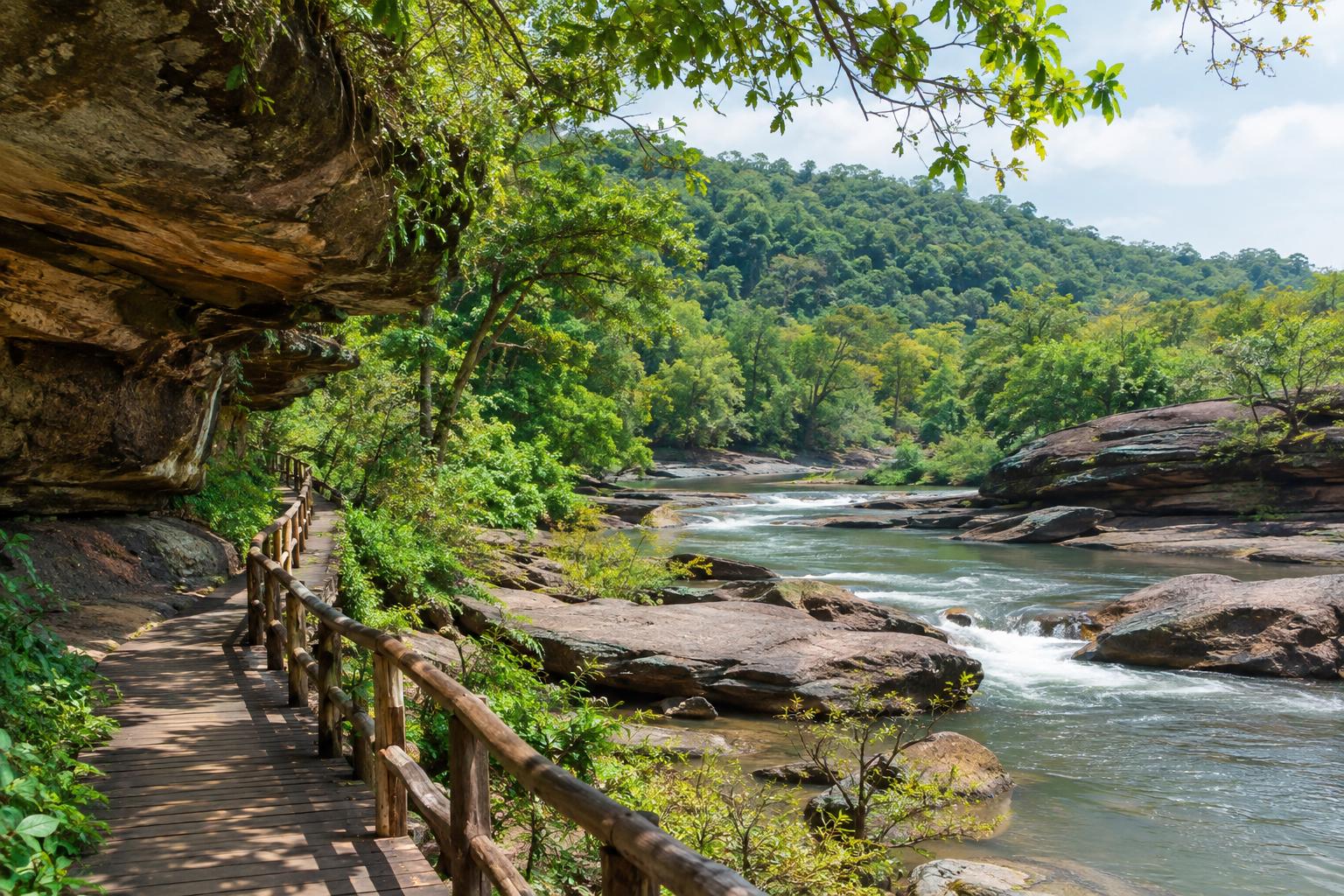
Thailand has launched Kaeng I Khiao in Ubon Ratchathani, a natural ecotourism site designed to promote conservation, support local communities, and provide a low-impact experience within protected forest areas.
Thailand has opened Kaeng I Khiao, a new ecotourism site in Ubon Ratchathani province, in a move that officials say is designed to support sustainable travel while bringing fresh income to communities near the Buntharik-Yot Mon Wildlife Sanctuary. According to The Nation, the project has been launched with environmental safeguards, visitor services and safety measures in place from the outset.
The attraction centres on a broad rock terrace crossed by a stream and set within intact forest, offering visitors a landscape shaped by water, stone and woodland rather than built-up tourist infrastructure. That combination gives the site a clear appeal for travellers looking for quieter, nature-led experiences, while also positioning it as an outdoor classroom for learning about biodiversity and conservation.
Ubon Ratchathani already has a strong conservation footprint. The province contains several protected areas, including the Buntharik-Yot Mon Wildlife Sanctuary, which is described in regional reference material as covering about 350 square kilometres and supporting a wide range of plant and animal life. Other nearby nature attractions, such as Kaeng Tana National Park and Huay Sai Yai Waterfall, underline the area’s wider potential for forest and river-based tourism.
The opening also reflects a broader policy trend in Thailand, where sustainable and community-based tourism has been promoted as a way to spread visitor spending beyond the country’s best-known destinations. Academic studies on tourism development in Ubon Ratchathani have argued for models that balance environmental protection with local participation, suggesting that carefully managed natural attractions can support both conservation and livelihoods.
At Kaeng I Khiao, that balance will depend on how well the rules are enforced. Officials have introduced first-aid support, visitor facilities and strict waste controls, including a requirement that visitors carry out their own rubbish. If those measures hold, the site could become a model for low-impact tourism in Thailand’s forest provinces, rather than simply another scenic stop.
Source Reference Map
Inspired by headline at: [1]
Sources by paragraph:
Source: Noah Wire Services
Noah Fact Check Pro
The draft above was created using the information available at the time the story first
emerged. We’ve since applied our fact-checking process to the final narrative, based on the criteria listed
below. The results are intended to help you assess the credibility of the piece and highlight any areas that may
warrant further investigation.
Freshness check
Score:
10
Notes:
The article reports on the official opening of Kaeng I Khiao as a new ecotourism destination in Ubon Ratchathani on September 18, 2026. This is the earliest known publication date for this event, indicating high freshness. The content does not appear to be recycled or republished from other sources, and there are no discrepancies in figures, dates, or quotes.
Quotes check
Score:
10
Notes:
The article includes direct quotes from Pichai Watcharawongpaiboon, director of the Protected Areas Regional Office 9, and Wichian Chinwong, chief of the sanctuary. These quotes are unique to this article and have not been found in earlier material, suggesting originality. No variations in wording or discrepancies have been identified.
Source reliability
Score:
10
Notes:
The article originates from The Nation Thailand, a reputable news organisation known for its coverage of Thai news. The information is corroborated by other sources, including the official website of the Protected Areas Regional Office 9, enhancing its reliability. There is no evidence of the content being summarised or aggregated from other publications.
Plausibility check
Score:
10
Notes:
The claims made in the article are plausible and align with known information about Ubon Ratchathani's conservation efforts and ecotourism initiatives. The details about Kaeng I Khiao's features, such as the rock terrace and surrounding forest, are consistent with the region's natural landscape. The article provides specific factual anchors, including names, institutions, and dates, and the language and tone are appropriate for the topic and region.
Overall assessment
Verdict (FAIL, OPEN, PASS): PASS
Confidence (LOW, MEDIUM, HIGH): HIGH
Summary:
The article meets all verification standards with high confidence. It provides original, timely, and reliable information about the opening of Kaeng I Khiao as a new ecotourism destination in Ubon Ratchathani. The content is corroborated by reputable sources, and there are no significant concerns regarding freshness, quotes, source reliability, plausibility, paywall issues, content type, or verification independence.